
Henrico County Historical Directory Collections
The documented historical shelf is broad, but its geography needs care. Henrico County does not have a verified, standalone run that covers every community and year. The strongest evidence is for regional Richmond volumes. That makes these volumes valuable for Henrico households connected to Richmond streetcar suburbs and postal routes, while also making it essential to check the actual address against parcel and deed evidence. Catalog listings establish that a volume exists at a holding institution. They do not prove that every Henrico address appears in it.
| Collection | Years | Where held | Access |
|---|---|---|---|
| Early Richmond directories | 1819; 1845-1860 | VMHC, Richmond Public Library, cataloged copies | Browse or arrange access; early entries may use descriptive locations |
| Richmond and greater-Richmond directory volumes | Nearly annual, 1870 to present | VMHC, Richmond Public Library, library databases | Name searching and, in later volumes, address work |
| Street-address directory sections | 1879/80 forward within the documented run | VMHC and Richmond-area directory holdings | Street alphabetically, then number numerically |
| HCPL genealogy databases | Current licensed access | Henrico County Public Library | Cardholder access to HeritageQuest and selected Ancestry for Virginians collections |
| Newspapers and obituary indexes | Times-Dispatch card index, roughly 1940s-1985; other runs vary | Library of Virginia, Richmond Public Library, Chronicling America | In person, microfilm, or digitized access where available |
Use the year printed on the volume, the city or suburban label, and the section consulted in every research note. A directory may show a Richmond heading while still offering the best available lead for a Henrico County address. Search both Henrico and Richmond labels rather than treating either one as a complete boundary test.
Henrico County Directories on a Richmond Shelf
The Virginia Museum of History & Culture property-research guide records several distinct runs: microfiche for 1819 and selected 1845-1860 volumes, microfilm from 1882/83 through 1935, and a general collection beginning in 1936. Its publisher trail includes the first John Maddox Richmond directory in 1819, H.K. Ellyson, Montague, Butters, Randolph, West, Ferslew, Boyd, Sheriff and Chataigne, Chataigne, Hill, and Greater Richmond or Hill Directory Company volumes. Treat publisher names as useful shelf markers, not as proof of a complete Henrico County series.
| 1819 | John Maddox issued the first documented Richmond directory, whose entries could use descriptive locations instead of house numbers. |
|---|---|
| 1845-1860 | Selected early volumes are documented on VMHC microfiche. |
| 1870 onward | The guide describes a nearly annual Richmond and greater-Richmond directory run. |
| 1879/80 | Street-address sections begin in the documented volumes. |
| 1882/83-1935 | VMHC identifies its Mss.10 microfilm runs for these years. |
| 1936 onward | The general collection at F234.5 R5 begins and continues to the current run. |
The VMHC directory-research resource is shown below. It documents the collection runs and the later street-address sections that make historical address work possible.
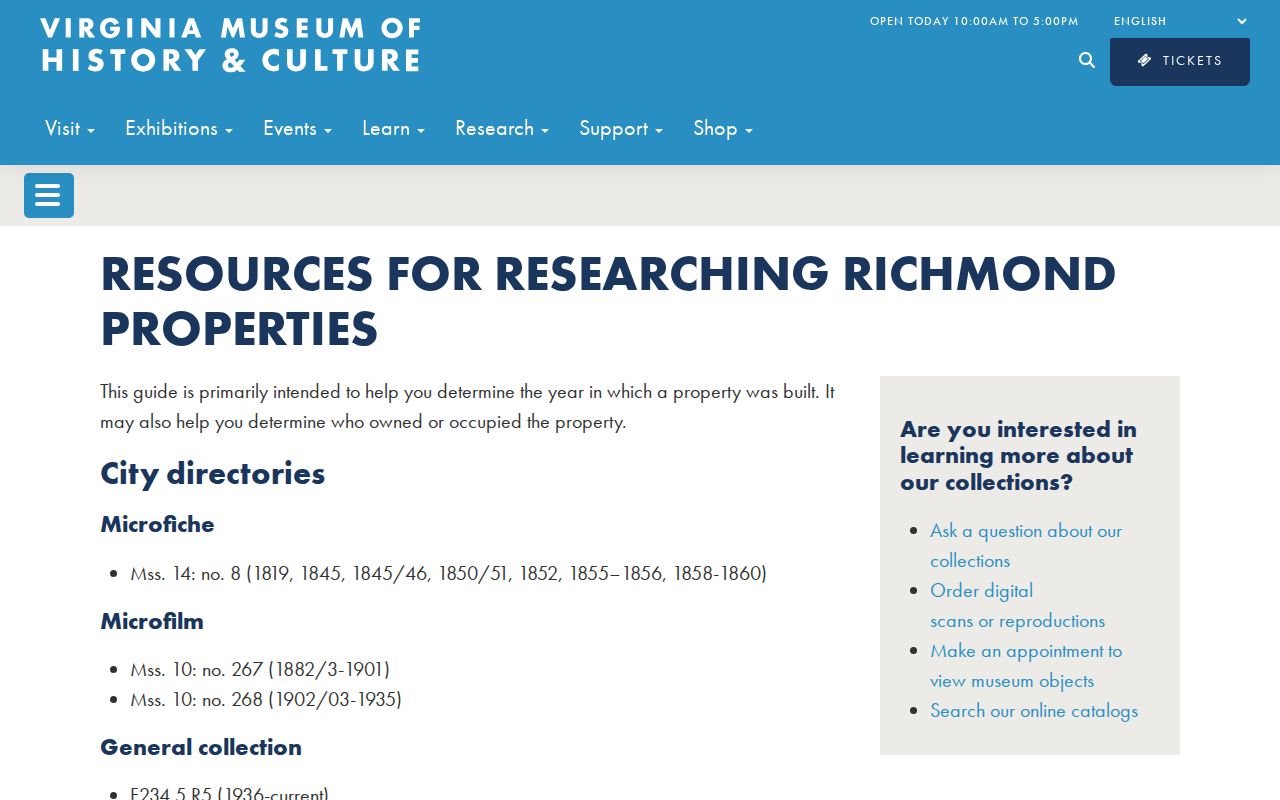
Its Richmond focus is the reason to record the neighborhood, street, cross street, and postal label beside each result. Henrico County communities can be represented in a regional context, not in an all-inclusive county volume.
Henrico County Street-Address Directory Sections
Beginning with the 1879/80 volume, the documented directories include a street-address section organized alphabetically by street and numerically by address. That feature is the practical bridge from a house number to a possible household. Search the street and number first. If the number does not appear, search the street without it, then nearby cross streets. For an earlier period, modern numbering may fail because the 1819 Maddox directory used descriptive locations instead of house numbers.
- Write down the address exactly as it is known today, including a former community label if one is available.
- Check the street-address section for the target year, then look for the name in the alphabetical section.
- Search one year before and after the target year for initials, shortened given names, spouse notations, or a move.
- For early volumes, substitute a street, cross street, occupation, household detail, or nearby institution for a missing number.
Note: A street-section hit is an address clue, not proof that the named person owned the parcel or stayed there continuously.
Reading a Henrico County Directory Entry
No representative Henrico-address entry was available in the inspected text-only sources, so the marks in a particular volume should be read from that volume rather than assumed. Capture the printed evidence carefully. A usable note preserves both what the entry says and how it was indexed. The items below are the verified inventory to record whenever the publication prints them.
| Indexed name | Record the surname and given name exactly as printed, including initials or spelling variants. |
|---|---|
| Household notation | Copy a spouse or household reference when the entry includes one. |
| Occupation | Preserve an occupation or named organization only when it appears in the entry. |
| Street reference | Keep the printed number, street, and whether the hit came from the name or street section. |
| Status notation | Record any owner, renter, widow, or similar mark only if the volume actually uses it. |
| Volume evidence | Save the directory year, page, abbreviation key, and the prior or next year checked. |
- Criss-cross directory
- The later street-address half of a directory, arranged by street and then address so an address can lead to a listed name.
- Householder index
- An alphabetical name arrangement centered on a listed resident or household. Check the publication label before deciding who was included.
- Abbreviation key
- The volume's own guide to its shortened terms and marks. Copy it before interpreting a notation.
Henrico County Directory Help at Local Libraries
Richmond Public Library's local-history service holds city and suburban directories from 1819 to the present, local yearbooks, newspapers, and research assistance. Most of the Richmond Room collection can be browsed during open hours, although appointments are encouraged for fragile or restricted material. HCPL adds a local access route: cardholders can use HeritageQuest and selected Ancestry for Virginians collections, while staff offer in-person and AskHCPL help. Neither licensed database should be assumed to contain every commercial collection or every directory year.
The HCPL genealogy resources illustrate the library route to historical directory volumes, census material, and research assistance.
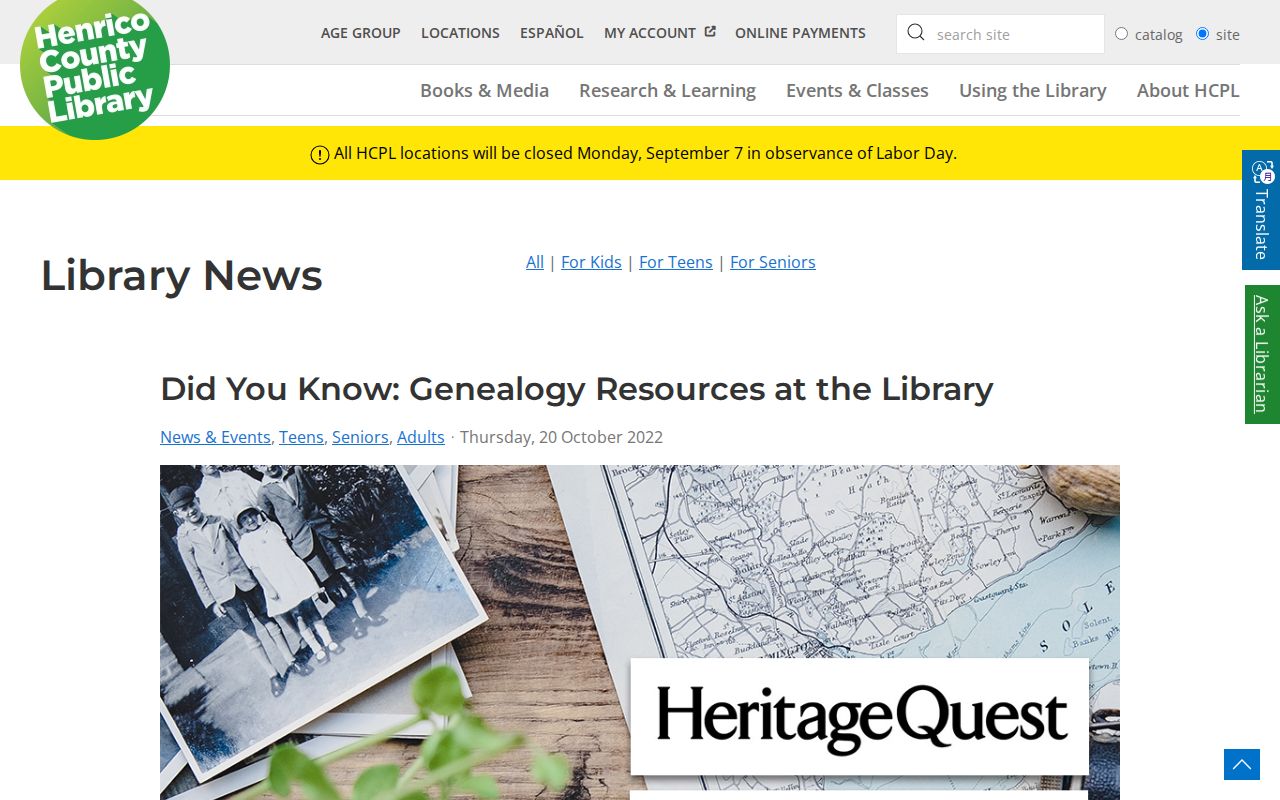
Use a library search as a way to locate a particular volume or household, then preserve the volume year and page so a later researcher can retrace the evidence.
Tracing a Henrico County Directory Household
A household trail works one year at a time. Start with the modern address and parcel owner when that is the known point, then test the address in a reverse directory. Work back carefully through name sections and street sections. Allow for abbreviated names, initials, spouse notation, and shifts between Richmond and Henrico postal labels. Pair directory years with federal census releases under the 72-year rule. A directory establishes a person's listed presence or association in a given year. It does not independently establish legal residence, ownership, or an unbroken household.
- Find the closest confirmed name or address in a dated directory and record the page and section.
- Move one volume at a time, noting each address change, name variation, and missing year.
- Use the street section to test whether the household appears at the same address or near a cross street.
- Pair the directory evidence with the available federal census for household composition, ages, relationships, streets, and birthplace fields.
- Use recorded deeds, permits, probate, or an obituary to test a move, death, or transfer suggested by the directory trail.
For current parcel and recorded-title evidence, the address workflow on the Henrico County street directory is the stronger next step. The city-directory volumes remain the historical shelf, not a replacement for a recorded instrument.
Henrico County Historical Directory Myth
Myth: a blank directory search proves that a household was absent. The record does not support that conclusion. A volume can be regional rather than countywide, a name can be abbreviated or misspelled, an address can be described instead of numbered, and the household may have used a Richmond or Henrico label different from the one searched. A person can also be omitted from a particular edition. Search the adjacent year and a second index before treating the gap as meaningful.
Another gap is historical rather than editorial. The Library of Virginia's Henrico microfilm catalog reports that all pre-1655 court records and almost all pre-1677 court records are missing, and that Revolutionary War destruction and the 1865 fire damaged or destroyed later court material. When a directory clue cannot be matched to a deed, will, or court book, the absence may reflect record loss. Surviving land grants, tithe lists, church registers, newspapers, probate, and nearby jurisdictions may help bridge it.
Note: Keep a failed search in the log with its spelling, volume, section, and label because a later source may explain it.
Henrico County Directory Digitization Tip
Insider tip: The July 2026 HCPL genealogy and digitization update highlighted high-resolution scanners, film and slide inserts, VHS conversion, open lab hours, HeritageQuest, historical directories, and genealogy resources. When a fragile volume or microfilm page is available for inspection, capture the page reference and a clear image of the entry and its surrounding heading. The heading establishes the year and section, which can matter as much as the line with the name.
HCPL's Notable Henricoans Database is another local-person lead, not a historical directory or raw resident list. It can be searched by title, gender, race or ethnicity, place of birth, field of influence, and keywords. Results expose a name, place of birth, field of influence, and birth information, with a biography route. Confirm a biographical lead against a directory, census, newspaper, deed, or vital record before connecting it to a particular household.
For a directory trail that ends with a probable death or move, the Library of Virginia and Richmond Public Library newspaper resources can supply an obituary, announcement, biography, or legal notice. The Richmond Times-Dispatch card index covers roughly the 1940s through 1985. Use that result as a dated lead, then connect it to a deed or probate record when the question concerns a parcel or an heir.